🌴 Turning Waste Into Fuel: How Coconuts in the Dominican Republic Can Power the Future of Aviation
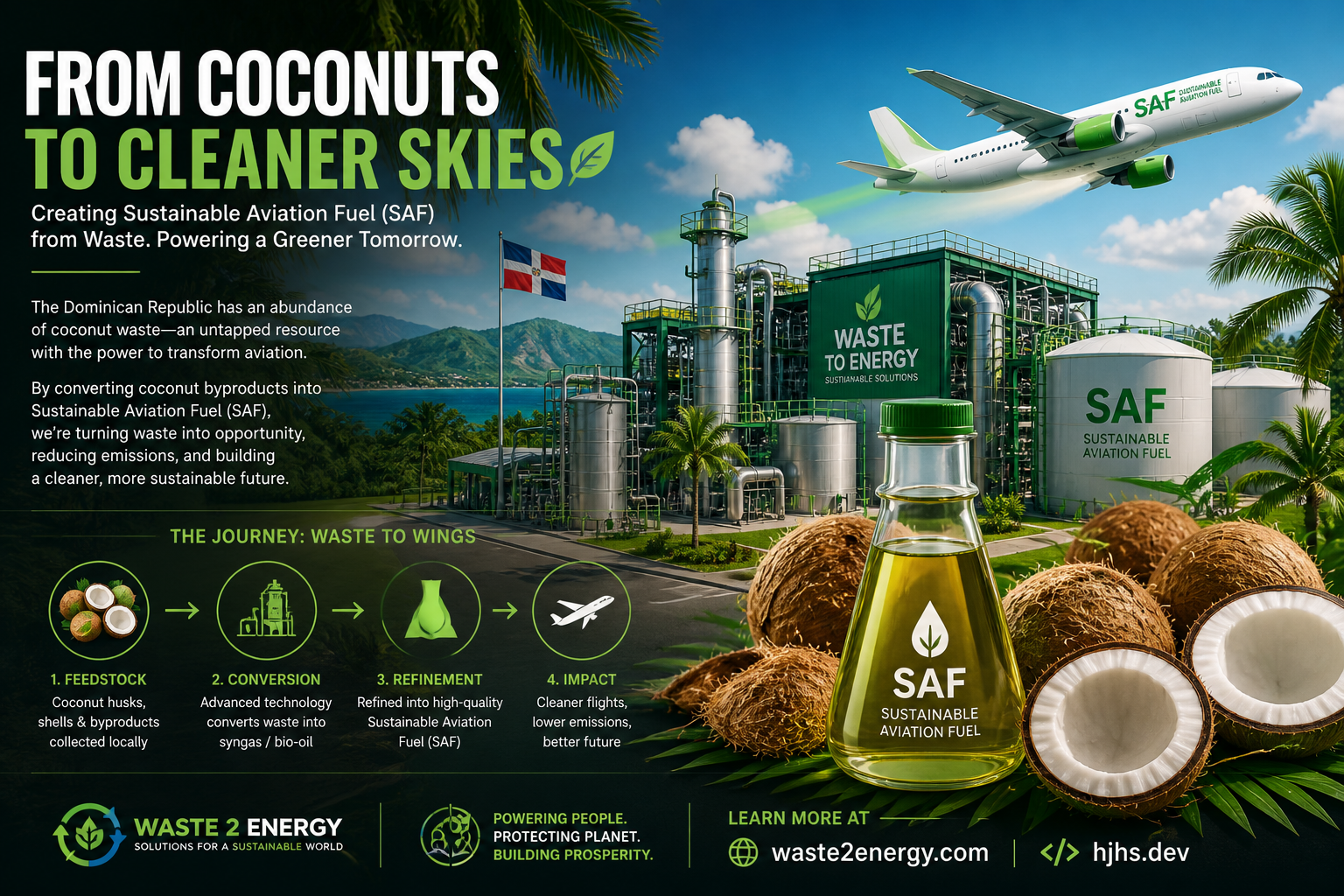
The Future of Fuel Isn’t Underground — It’s Growing All Around Us
For decades, the world has relied on fossil fuels pulled from the earth. But the next generation of energy is being built differently — not extracted, but regenerated.
In places like the Dominican Republic, a powerful opportunity is emerging: transforming agricultural waste — especially coconut byproducts — into Sustainable Aviation Fuel (SAF).
This isn’t theory. It’s a scalable, real-world solution already gaining global attention.
What Is SAF (Sustainable Aviation Fuel)?
Sustainable Aviation Fuel (SAF) is a cleaner alternative to traditional jet fuel, designed to:
Reduce lifecycle carbon emissions by up to 80%
Work with existing aircraft engines (no redesign needed)
Help airlines meet strict global emissions targets
The challenge? Feedstock.
And that’s where coconuts — and waste — come in.
Why Coconuts? The Hidden Energy Resource
The Dominican Republic produces massive volumes of coconut-based agricultural waste:
Coconut husks
Shells
Residual biomass
Most of this is discarded or underutilized.
But chemically, this material is rich in carbon — making it an ideal input for thermochemical conversion processes like:
Gasification
Pyrolysis
Fischer-Tropsch synthesis
These processes convert organic waste into clean-burning synthetic fuels, including SAF.
From Waste to Jet Fuel: How It Works
Step 1: Collection & Aggregation
Local farms and processing centers supply coconut waste at scale.
Step 2: Conversion
Advanced systems convert biomass into syngas or bio-oil.
Step 3: Refinement
The material is refined into aviation-grade fuel.
Step 4: Distribution
Fuel enters existing aviation infrastructure — ready for global use.
Why the Dominican Republic Is a Perfect Fit
The DR isn’t just a beautiful destination — it’s strategically positioned for SAF production:
🌴 Abundant agricultural waste (coconuts + more)
🌎 Proximity to major aviation routes
⚡ Growing demand for sustainable infrastructure
💼 Increasing investor interest in green energy
This creates a rare alignment of resources + location + global demand.
The Bigger Picture: Waste2Energy
Coconut-based SAF is just one piece of a larger movement:
Turning waste into energy across multiple sectors:
Municipal solid waste → electricity
Agricultural byproducts → fuels
Organic waste → clean industrial inputs
This approach doesn’t just reduce emissions — it:
Eliminates landfill dependency
Creates local jobs
Builds energy independence
Unlocks new revenue streams
Why This Matters Now
Global aviation is under pressure to decarbonize fast.
Airlines, governments, and investors are all searching for scalable SAF solutions.
The reality is simple:
The countries and companies that solve feedstock + production first…
will define the future of global energy.
Final Thought
What was once considered waste is now one of the most valuable resources on the planet.
And in places like the Dominican Republic, the solution is already growing on trees.
🚀 Learn More
Explore how Waste-to-Energy and sustainable fuel initiatives are shaping the future:
👉 Learn more at:
https://waste2energy.com
https://hjhs.dev